Since its founding in 2010, the Sport & Society Research Network has evolved into a dynamic, interdisciplinary community connecting the study of sport’s social meanings with its political, economic, and cultural realities. Across fifteen years of conferences, publications, and collaborations, the Network has traced how sport both mirrors and shapes the changing conditions of global society.
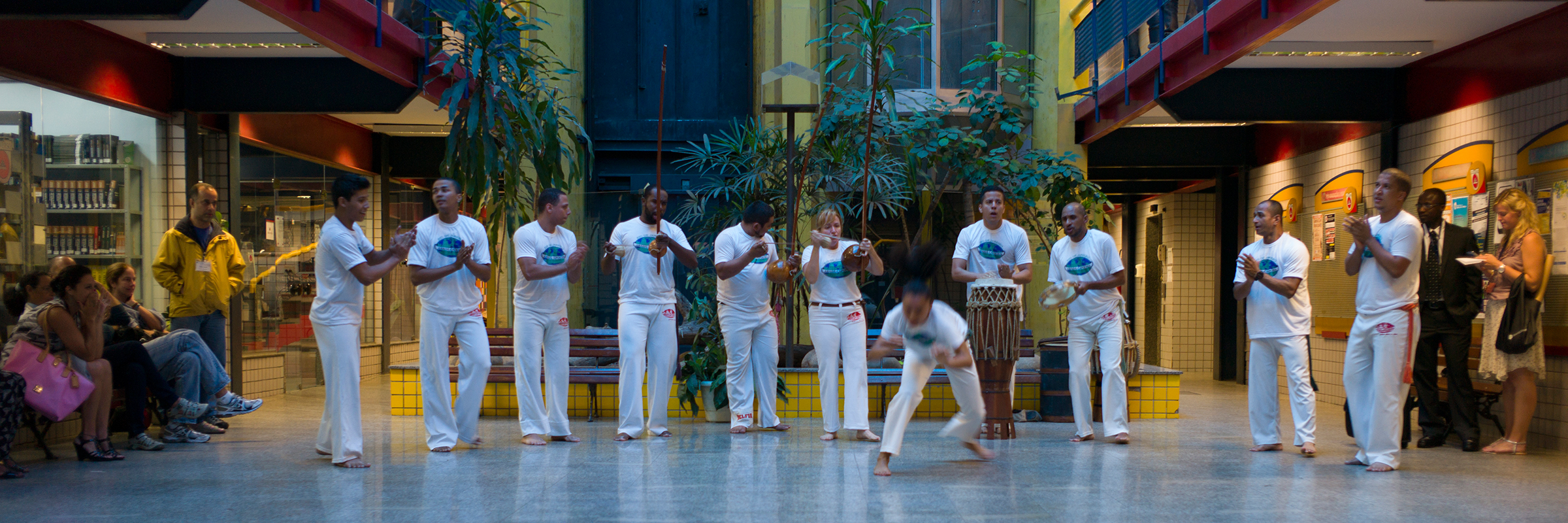
Fifth International Conference on Sport and Society, Universidade Salgado de Oliveira, Rio de Janeiro, Brazil (2014)
A Short History
Exploring the cultural, political, and economic dimensions of sport in society.
The Sport & Society Research Network brings together researchers, practitioners, policymakers, and athletes to examine the social meanings and impacts of sport. Member-based and scholar-led, the Network explores how games, bodies, and organizations reflect and reshape contemporary life—from identity and health to education,
The Sport & Society Research Network story begins in Vancouver, Canada, where the inaugural International Conference on Sport & Society coincided with the 2010 Winter Olympic Games. Led by Founding Chair Keith Gilbert (University of East London), the gathering offered a critical counterpoint to the Olympic spectacle unfolding nearby—a space for inquiry into fairness, identity, power, and the social meanings of sport. While the world celebrated performance and national achievement, the conference initiated a parallel conversation about the cultural, ethical, and political forces that make sport a lens onto modern life.
Since 2019, the Network has been led by Jörg Krieger (Aarhus University), whose work on athlete activism, anti-doping governance, and the politics of international sport has broadened its reach and sharpened its focus on integrity, accountability, and athlete agency. Together, Gilbert and Krieger have positioned the Network as a forum for evidence-based research and ethical dialogue across sporting cultures.
From its beginnings in Vancouver, the International Conference on Sport & Society has partnered with leading institutions around the world. These include Cambridge University (UK), Universidade Salgado de Oliveira in Niterói (Brazil), the University of Toronto (Canada), the University of Hawai‘i at Mānoa (USA), Imperial College London (UK), Florida International University (USA), Ryerson University (Canada), the University of Granada (Spain), Aarhus University (Denmark), the University of Nevada, Las Vegas (USA), and Monash University (Australia). Each host location introduces its own sporting histories, political contexts, and community priorities—extending the Network’s vision of sport as both a local practice and a global field of imagination, conflict, and shared challenge.
Across its history, the Network has welcomed influential figures whose work has shaped debates about sport and society. These include Richard Pound (International Olympic Committee), Wilfried Lemke (United Nations Office on Sport for Development and Peace), Richard Giulianotti (Loughborough University), Eric Anderson (University of Winchester), Paul McDougall (CBC Sports), and other scholars, journalists, and leaders. Their contributions span governance, ethics, gender and identity, athlete rights, urban development, and the social futures of sport—reinforcing the Network’s commitment to critical, interdisciplinary, and globally informed scholarship.
The International Journal of Sport and Society publishes peer-reviewed research on game logics, movement and body cultures, sport media, health, governance, and the political economy of sport. Indexed in Scopus, SPORTDiscus, IBSS, ProQuest, and ARC, the journal maintains a COPE-aligned, double-anonymous review process. Each year, the Network awards the Sport & Society International Award for Excellence, honoring one article selected from the highest-ranked peer-reviewed submissions. Recent award-winning work has examined the representation of women athletes in media, racialized dynamics in sport commentary, leadership cultures in team environments, and the economic politics of global athletics.
The Sport & Society Book Imprint supports long-form scholarship across sociology, history, kinesiology, pedagogy, management, physical culture, and sport ethics. Its catalog includes monographs, edited collections, and two distinct series—the Teaching Pocketbook Series, offering concise introductions to key concepts such as hegemony, sportswashing, and gender in sport; and Sharp Ideas in Sport, which promotes critical, provocative, and forward-looking arguments in sport scholarship. Open Access pathways extend the reach of this work to global audiences, from researchers and students to coaches, journalists, and policymakers.
Today, the Sport & Society Research Network continues to foster interdisciplinary dialogue on how sport expresses social values, structures institutional power, and shapes collective life. Through its annual conference, journal, book imprint, and CGScholar community, the Network offers a member-based, scholar-led space for examining sport as a site of identity, politics, imagination, and social change.
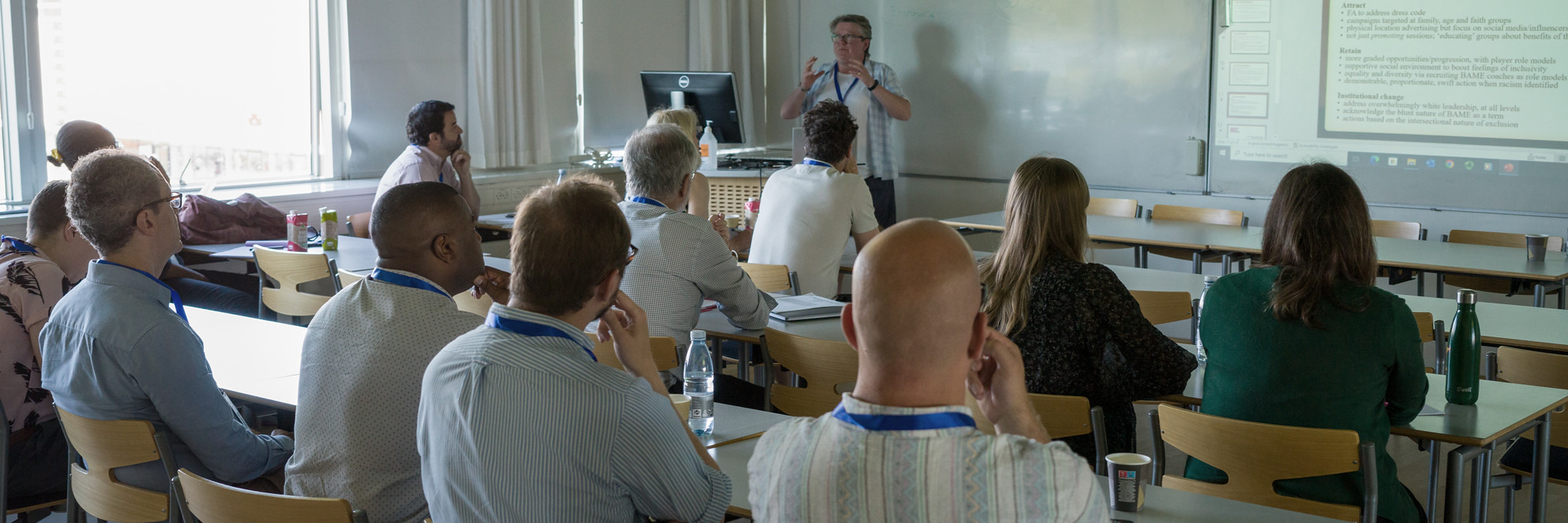
Thirteenth International Conference on Sport & Society, Aarhus University, Aarhus, Denmark (2022)
Research Network Chairs
The Network is led by Chair Jörg Krieger (Aarhus University, Denmark), whose research examines the politics of elite sport, anti-doping, and athlete activism. The Founding Chair was Keith Gilbert (University of East London, United Kingdom), who established the Network’s global and interdisciplinary foundation. Under their leadership, the Network continues to expand its reach—supporting methodological innovation and ethical dialogue in the study of sport and society.