Call for Papers
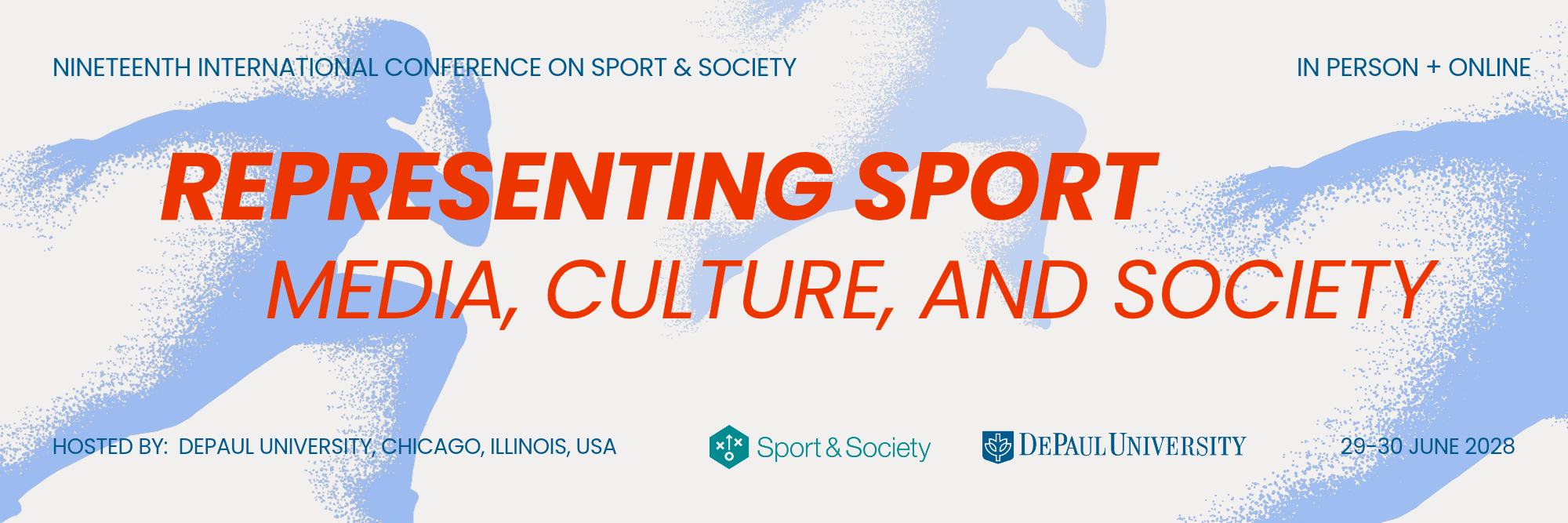
We invite you to join us for the Nineteenth International Conference on Sport & Society, the annual meeting of the Sport & Society Research Network, hosted by DePaul University, taking place in Chicago, Illinois, USA, and online, 29–30 June 2028.
Founded in 2010, the Sport & Society Research Network brings together researchers, educators, athletes, coaches, journalists, media practitioners, sport administrators, and community organizers to examine the cultural, political, and economic relationships between sport and social life. We welcome work that connects the experience of playing, watching, and organizing sport with questions of identity, health, education, power, and belonging.
Sport reaches people through much more than the contest itself. Commentary, photographs, documentaries, statistics, advertising, and the stories shared among supporters shape what audiences see and what they remember. These representations influence whose achievements are recognized, which bodies are valued, how communities understand themselves, and what responsibilities sporting institutions are asked to uphold.
Special Focus and Themes
The 2028 special focus, Representing Sport: Media, Culture, and Society, invites participants to examine how sport is made visible, interpreted, and contested—and how these processes shape the sporting world itself.
A sporting moment can become a national story, a commercial asset, an image of resistance, or a source of collective memory. Yet visibility is uneven. Some athletes and competitions command sustained attention, while others struggle for coverage, resources, and recognition. The terms of representation matter: who is described as talented, disciplined, threatening, inspirational, or out of place? Who has the authority to speak, and whose experience is reduced to a familiar storyline?
The boundaries between athletes, audiences, and media producers are also shifting. Athletes publish their own accounts; supporters create commentary and archives; streaming services and social platforms influence how competitions are encountered. These opportunities raise questions about editorial independence, ownership, labor, harassment, access, and the commercial pressures attached to public visibility.
Chicago offers a productive setting for this inquiry. The relationships among teams, neighborhoods, sporting venues, and public identity invite discussion of how sport helps people narrate a city—and how those narratives can reveal or obscure differences in opportunity, investment, and belonging. Meeting at DePaul University, we will connect these questions of place with the international circulation of sporting images, stories, and identities.
We invite contributions that ask how sport might be represented with greater accuracy, imagination, and accountability. How do media practices reinforce or challenge inequalities of race, gender, class, sexuality, and disability? How are women’s sport, disability sport, youth sport, and community participation framed? What can journalism, cultural criticism, historical research, education, and creative practice contribute to a fuller understanding of sporting life?
Themes Exploring the Special Focus
- Theme 1: Sporting Stories, Images, and Public Memory: exploring how sport is narrated through journalism, broadcasting, photography, film, literature, museums, and digital archives. Contributions may examine commentary, documentary practice, sporting heroes, historical memory, national narratives, and the ethical responsibilities of those who document and interpret sport.
- Theme 2: Visibility, Identity, and the Sporting Body: examining how representation shapes recognition, participation, and belonging. We welcome work on race, gender, class, sexuality, disability, body image, athletic performance, and the narratives through which athletes and communities challenge exclusion or negotiate public expectations.
- Theme 3: Platforms, Audiences, and the Business of Attention: considering the institutions and technologies that organize sporting visibility. Topics include broadcast rights, streaming, social media, athlete self-representation, fan production, sponsorship, branding, data, artificial intelligence, and the labor and ownership arrangements behind sport media.
- Theme 4: Sport, Voice, and Cultural Change: investigating how sport becomes a space for public debate, education, advocacy, and collective action. Contributions may address athlete activism, community storytelling, supporter cultures, media literacy, institutional accountability, and the relationship between sporting narratives and social change.
Core Research Network Themes
Alongside the special focus, we welcome proposals across the Sport & Society Research Network’s ongoing themes: sporting cultures and identities; sport and health; sports education; and sports management and commercialization. Proposals do not need to address the special focus.
Contributions may be theoretical, empirical, historical, methodological, professional, creative, or grounded in community practice.
Knowledge Experience and Format
The conference is organized as a hybrid knowledge experience, bringing in-person and online contributions into a shared scholarly environment.
For in-person delegates in Chicago, sessions, talking circles, and informal exchanges provide opportunities to put research into conversation with journalism, coaching, education, cultural production, and the everyday work of sporting organizations. The emphasis is on discussion across professional and disciplinary perspectives, with room to question familiar accounts of sport and develop new ones together.
Online delegates contribute through Presentation Pages, digital media, live online sessions, and asynchronous discussion. These spaces allow participants to encounter one another’s work, share supporting materials, and continue conversations beyond the scheduled session. Across both modes, the conference is designed to support sustained exchange and future collaboration.
Publication Pathways
All accepted proposals are included in the conference proceedings, creating a record of the program and presentation abstracts within the Research Network’s continuing body of work.
Presenters are invited to develop their contributions for possible publication in The International Journal of Sport and Society, the Network’s peer-reviewed journal. Prospective authors can consult the journal’s submission guidelines.
Longer-form projects may be proposed to the Sport & Society Book Imprint, including monographs and edited collections examining sport’s relationships with culture, media, institutions, embodiment, and public life.
Member-Based Research Community
Membership in the Sport & Society Research Network connects conference participation with a year-round community of inquiry. Members receive personal electronic access to Network journal and book publications, conference registration discounts, publishing benefits, access to digital media archives, online programming, and opportunities to share work and build professional relationships.
Membership is included in all conference Presenter Passes.
Join Us
We warmly invite you to submit a proposal and join us in Chicago or online for the Nineteenth International Conference on Sport & Society.
Bring the stories you study, the practices you question, and the perspectives that deserve a wider hearing. Together, we will explore how representations of sport shape social life—and how research and practice can make those representations more inclusive, critical, and responsive to the people they concern.
Regards,
Dr. Jörg Krieger, Research Network Chair, Aarhus University, Denmark & University of Inland Norway, Norway
Dr. Phillip Kalantzis-Cope, Chief Social Scientist, Common Ground Research Networks, United States of America
Dr. Vincent Peña, Local Conference Chair, DePaul University, United States of America